Win Loss Analysis: Operational Guide for Sales and Product Teams

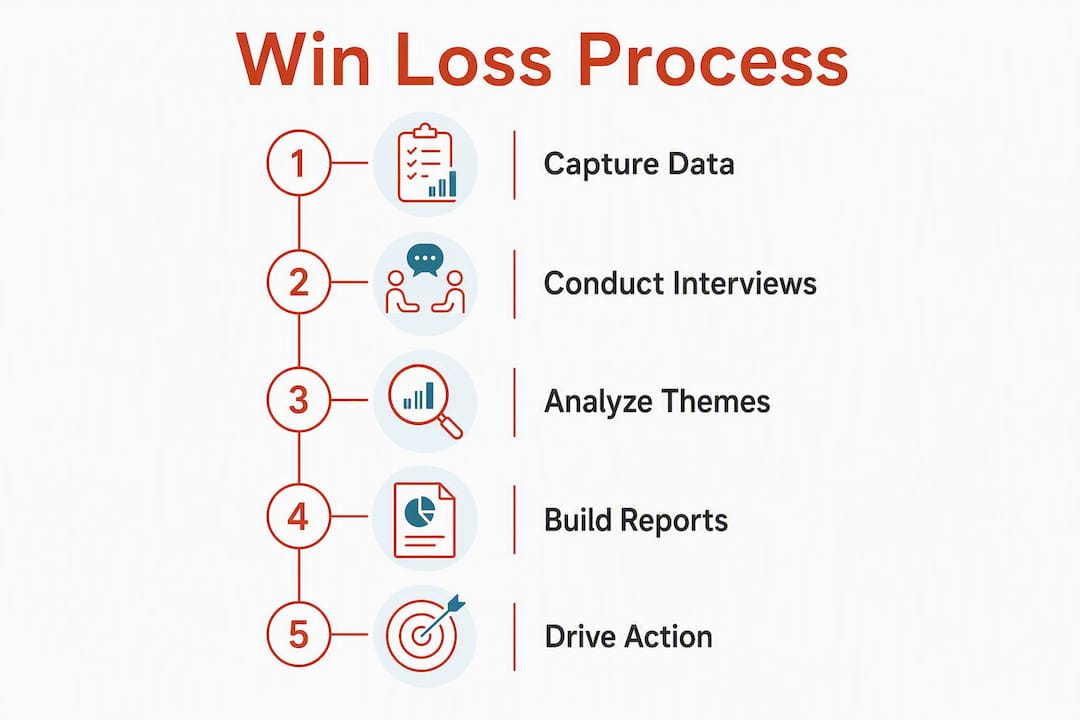
Win loss analysis is the structured practice of reviewing every closed deal to understand exactly why you won, lost, or failed to get a decision at all. Run it continuously on every closed deal for lightweight rep self-reports, conduct deep-dive buyer interviews on a sampled subset, and review patterns quarterly with your full go-to-market team. The three fastest payoffs:
- Faster deal fixes: Surface the real objections reps face this week, not last quarter.
- Sharper messaging: Align positioning to what buyers actually value, not what marketing assumed.
- Better product prioritization: Route buyer-reported gaps directly to the product roadmap.
Recommended cadence: capture structured data on every closed deal, update artifacts monthly, and run a cross-functional pattern review quarterly.
Table of Contents
- What win loss analysis actually measures (and how to calculate it)
- Why a disciplined program pays off across the whole GTM team
- How to design, pilot, and scale a win loss program
- How to conduct buyer interviews and get honest answers
- How to analyze data, surface themes, and build reports that change behavior
- Turning insights into sustained GTM operations
- Common pitfalls that kill programs before they produce results
- How to train interviewers and analysts for consistency
- How win loss insights connect to broader sales and marketing strategy
- How to design interview questions for different stakeholders
- Techniques for getting unbiased, honest responses
- Key Takeaways
- Why most programs fail before they get good
- Launchbrief gives you sourced GTM intelligence without the research overhead
- Useful sources and further reading
What win loss analysis actually measures (and how to calculate it)
A win loss program pulls intelligence from four signal layers: the stated reasons buyers give for their decision, observed behavior in calls and deal timelines, competitive context (who else was in the deal and how they were positioned), and pattern analysis across a cohort of deals. No single layer tells the full story.
The most common metric is simple win rate: wins divided by total closed deals (wins plus losses plus no-decisions). If you closed a number of deals and won just over half, your simple win rate is about half of your total closed deals. That number is useful as a baseline, but it flattens important differences. A $20,000 deal and a $200,000 deal count equally. Win rate can also be calculated as a revenue-weighted figure — revenue won divided by total revenue in closed deals — which gives a more accurate picture of where you are actually competitive. Segment-level win rate, calculated for a specific product line, territory, or buyer persona, is the most useful for diagnosing specific problems.
Beyond win rate, track these companion metrics:
- No-decision rate: Deals where the buyer chose to do nothing. A rising no-decision rate often signals a positioning or urgency problem, not a competitive one.
- Loss-reason frequency: How often each coded loss reason appears across a cohort. Frequency tells you where to focus first.
- Deal-stage fallout: Which stage of the pipeline loses the most deals. Late-stage losses after a demo suggest a different problem than early-stage losses before a proposal.
- Time-to-close by outcome: Deals that drag on and then lose often signal a qualification failure, not a competitive one.
On sample size: Programs that interview 8–12 buyers per quarter produce directional color but not statistically reliable patterns. Treat small samples as hypotheses to test, not conclusions to act on.
Analysis of millions of recorded B2B buyer conversations found that most late-stage deal failures trace back to product fit, buying experience, and perceived risk rather than price. That finding alone should make you skeptical of any CRM where "price" is the top loss reason by a wide margin.
Why a disciplined program pays off across the whole GTM team
The business case for win loss analysis is not subtle. Companies that run structured programs for two or more years consistently report measurable improvements in win rate. The mechanism is straightforward: you stop guessing at the problem and start fixing the actual one.
Each team extracts different value:
- Sales: Reps get updated battlecards, real objection language from buyers, and discovery questions that reflect current competitive dynamics.
- Product: Gaps reported by buyers in lost deals feed directly into roadmap prioritization, with evidence rather than anecdote.
- Marketing: Messaging and positioning get tested against what buyers actually said during evaluation, not what the team assumed resonated.
- Customer success: Win reasons tell CS what buyers expected when they signed, which reduces early churn from unmet expectations.
- Leadership: Aggregate patterns reveal whether a declining win rate is a rep execution problem, a product gap, or a competitive shift.
The caution worth stating plainly: a program that produces a quarterly PDF nobody reads has not improved anything. The output has to reach reps in the workflow where they need it, which means battlecards, pipeline meeting agenda items, and live objection lists, not slide decks filed in a shared drive.
How to design, pilot, and scale a win loss program
The fastest path to a working program is a six-step sequence. Skip steps and you get a program that generates data nobody trusts.
- Define scope and assign an owner. Decide which deal types and segments to analyze first. Assign one person who is accountable for the program, not a committee. This owner coordinates capture, interviews, analysis, and distribution.
- Build the CRM schema. Standardize the fields every rep fills out on every closed deal: primary competitor, win/loss/no-decision category, deal stage at loss, buyer persona, and evaluation criteria mentioned. These fields are non-negotiable; without them, you have no baseline dataset.
- Stand up lightweight continuous capture. A 5–10 minute rep self-report on every closed deal is the foundation. Keep it short enough that reps actually complete it. This is your highest-volume signal.
- Select a sample for deep-dive interviews. Aim for a balanced sample across outcomes. A 40/40/20 split of losses, wins, and no-decisions is a reasonable starting target. Prioritize recent deals (within 2–4 weeks of close) and deals where the rep self-report diverges from what you expected.
- Code and analyze patterns. Tag each interview and self-report with a standardized loss-reason taxonomy. Look for themes that appear across multiple deals, not just one memorable story.
- Update artifacts and distribute. Translate findings into battlecard updates, discovery question revisions, and objection-handling guides. Push these to reps through the channels they already use.
Roles and responsibilities
| Role | Responsibility |
|---|---|
| Program owner | Coordinates capture, schedules interviews, maintains taxonomy, runs quarterly review |
| Sales rep | Completes self-report within 48 hours of close; flags deals for interview |
| Neutral interviewer | Conducts buyer interviews; may be a product manager, researcher, or third party |
| Competitive lead | Updates battlecards based on findings; owns competitor-specific themes |
| GTM leadership | Reviews quarterly patterns; approves artifact changes and messaging updates |
Pilot timeline: In the first four weeks, finalize CRM fields, train reps on the self-report form, and conduct your first five buyer interviews. By week eight, you should have enough data to run a first pattern review and produce at least one updated battlecard. A full quarterly cycle gives you the first reliable cohort.
Launch checklist:
- CRM fields live and required on closed-deal records
- Consent language drafted for buyer interview outreach
- Interview script finalized (10 questions or fewer)
- Pipeline meeting slot reserved for monthly loss-reason review
- Artifact update schedule agreed (monthly minimum)
How to conduct buyer interviews and get honest answers
Who conduct the interview matters as much as what they ask. Allowing the sales rep who owned the deal to run the interview consistently reduces candor. Buyers soften criticism, avoid conflict, and default to polite answers when talking to someone they negotiated with. A neutral third party, a product manager, a researcher, or an external firm, gets materially more honest responses.
Request the interview within 2–4 weeks of close, keep the script to 10 questions or fewer, and offer a modest thank-you incentive (a $50 gift card is a common and effective choice). Response rates drop sharply after a month.
Survey vs. interview: Use a short survey (5–7 questions) when you need volume across a large deal cohort and the deal was relatively small. Use a structured 25-minute interview when the deal was significant, the rep self-report diverges from expectations, or you need to probe the "why" behind a stated reason. Interviews generate the qualitative depth that surveys cannot.
The laddering technique
After a buyer gives a surface reason ("your price was too high"), probe three levels deeper before accepting it. Ask what specifically felt out of range, then what they compared it to, then what the budget decision was actually based on. With consistent laddering, price turns out to be the real driver in far fewer deals than the initial answer suggests. The underlying issue is usually perceived risk, unclear ROI, or a product gap that made the price feel unjustifiable.
This is why sales reps are wrong about the actual reason for a loss more than 60% of the time. The buyer's stated reason and the real reason are often different, and only a skilled, neutral interviewer probing with laddering will find the gap.
Sample question areas by outcome:
- Loss interviews: What were the top two or three factors in your final decision? What would have needed to be different for us to win? Who else was in the evaluation and what did they do better?
- Win interviews: What made you confident enough to move forward? What almost stopped you? What would you tell a peer considering us?
- No-decision interviews: What caused the project to stall? What would need to change internally for this to move forward?
Pro Tip: Always close with "Is there anything I haven't asked that you think we should know?" Buyers often volunteer the most useful information when they feel the formal script is over.
Ethical and practical considerations: Be transparent about how responses will be used. Assure buyers that their specific comments will not be shared with the rep who owned their deal. This single assurance meaningfully increases candor.
How to analyze data, surface themes, and build reports that change behavior
Raw interview notes and CRM fields are not insights. The analysis step is where the program earns its value.
The triangulation workflow: For each deal, compare three signals: the rep self-report, the buyer interview, and any observed data from call recordings or deal timeline. When all three align, you have a reliable signal. When they diverge, the divergence is the insight. A rep who codes a loss as "price" while the buyer interview reveals a product gap and the call recording shows the demo never addressed the buyer's primary use case, that divergence tells you far more than any single signal would.

Coding and theme detection: Assign each deal a primary loss reason and up to two secondary reasons from a fixed taxonomy. After 20 or more deals, look for themes that appear in at least 15–20% of the cohort. A theme appearing in two or three deals is an anecdote. A theme appearing in eight of thirty deals is a pattern worth acting on.
Sample report structure
| Report element | What it contains |
|---|---|
| Win rate summary | Simple and revenue-weighted win rate by segment, compared to prior quarter |
| Top loss reasons | Frequency table of primary loss reasons, ranked by occurrence |
| Competitive summary | Win/loss record by named competitor; key differentiators buyers cited |
| Theme narratives | 3–5 qualitative themes with supporting buyer quotes (anonymized) |
| Action tracker | Specific artifact updates, owners, and due dates |
Turning findings into artifacts: Every pattern that appears in the report should map to at least one artifact update. A recurring objection about integration complexity becomes a new objection-handling card. A competitive theme where a rival is consistently winning on a specific feature becomes a battlecard update. A discovery gap where reps are missing a key buyer question becomes a new addition to the discovery framework.
Distribute updates through the channels reps already use: Slack, your CRM's battlecard tool, or your sales enablement platform. A PDF emailed to the team is not distribution.
Turning insights into sustained GTM operations
A win loss program that runs for one quarter and then fades is worse than no program at all. It creates the impression of rigor without the results. Sustained programs require governance, not just good intentions.
Governance checklist:
- One named program owner with protected time (typically 20–30% of one FTE for a mid-size team)
- Competitive leads assigned to each major rival, responsible for battlecard freshness
- Loss-reason leads who own specific themes and track whether interventions are working
- A standing pipeline meeting agenda item for recent losses (weekly or biweekly)
- Monthly artifact refresh cycle with a published update log
Cadence in practice: Weekly pipeline reviews should include a standing five-minute slot: "What did we lose this week and why?" Monthly, the program owner publishes a one-page update with the top three themes and any artifact changes. Quarterly, the full GTM team reviews aggregate patterns, competitive shifts, and win-rate trends by segment.
Effort and cost: Standing up a program from scratch typically requires 40–60 hours of setup work (CRM schema, script development, training). Ongoing maintenance runs roughly 10–15 hours per month for a team closing 20–40 deals per quarter. External interview firms charge $200–$500 per completed interview; internal interviewers reduce that cost but require training and protected time.
Measuring program effectiveness: Track these metrics to know whether the program itself is working:
- CRM self-report completion rate (target: 90%+ of closed deals)
- Interview completion rate against the quarterly target
- Battlecard freshness (days since last update per competitor)
- Win-rate change by cohort, before and after a specific intervention
- Rep adoption of updated artifacts (measured through enablement platform analytics)
If the output is a quarterly PDF that sits unread, the program has failed. The right measure of success is behavior change: reps using updated battlecards, discovery questions evolving, and win rate moving in the right direction within two to three quarters of consistent operation.
Common pitfalls that kill programs before they produce results
Most win loss programs fail for predictable reasons. Knowing them in advance is the fastest way to avoid them.
Top pitfalls:
- Small, biased samples: Interviewing only the deals you remember, or only losses, produces skewed patterns. Balance wins, losses, and no-decisions.
- Rep-led interviews: Buyers give polished, conflict-avoiding answers to the person they negotiated with. Neutral interviewers are not optional.
- Single-signal reliance: CRM loss codes alone are systematically biased. Triangulate.
- Stale artifacts: A battlecard that hasn't been updated in six months is worse than no battlecard. It gives reps false confidence.
- Treating anecdotes as patterns: Two deals with the same loss reason is not a trend. Wait for a cohort before acting.
- No action tracker: Findings that don't map to a named owner and a due date don't get implemented.
Red flags that should trigger a program review:
- No-decision rate rising quarter over quarter
- CRM loss reasons diverging significantly from buyer interview themes
- Battlecards not updated in more than 60 days
- Rep self-report completion rate below 70%
- No artifact has been changed in the past two months despite ongoing losses
10-point best-practice checklist:
- Assign one program owner with explicit accountability.
- Require CRM self-reports on every closed deal, not just losses.
- Use a neutral interviewer for all buyer conversations.
- Sample wins, losses, and no-decisions in every cohort.
- Apply laddering in every interview to get past surface answers.
- Code every deal with a standardized taxonomy before analyzing.
- Wait for a minimum of 15–20 deals before calling a theme a pattern.
- Map every finding to a specific artifact update with an owner.
- Distribute updates through the channels reps already use.
- Review program health metrics (completion rates, artifact freshness) monthly.
How to train interviewers and analysts for consistency
A program is only as consistent as the people running it. Two interviewers using different probing styles will produce data that can't be compared. Two analysts coding with different definitions of "product gap" will produce a theme frequency table that means nothing.
Interviewer training should cover three areas. First, the mechanics: how to open a call to establish neutrality, how to use laddering without leading the buyer, and how to handle a buyer who gives only surface answers. Role-playing with a colleague before the first live interview is the fastest way to build this skill. Second, the taxonomy: every interviewer needs to understand what each loss-reason code means and where the boundaries are between adjacent categories. Third, bias awareness: interviewers should know the most common ways buyers soften feedback (blaming price, praising the team while criticizing the product) and how to probe past those patterns.
Analyst calibration is equally important. Run a calibration session at the start of each quarter: give two analysts the same set of five interview transcripts and have them code independently. Compare results. Any code where they disagree by more than one category signals a definition that needs tightening. Document the agreed definitions in a shared codebook and update it when new edge cases appear.
For ongoing quality, record buyer interviews (with consent) and review a random sample monthly. This lets you catch drift in interviewer technique before it corrupts a full quarter of data. New analysts should shadow three to five interviews before coding independently.
How win loss insights connect to broader sales and marketing strategy
The findings from a win loss program are most valuable when they flow into the systems your team already uses, not when they live in a separate report.

Sales strategy integration: Loss themes feed directly into rep coaching. If a pattern shows that win rate drops when procurement gets involved late in the deal, that's a coaching target: how to bring procurement in earlier and what to say when they arrive. Discovery frameworks should be updated quarterly based on the questions buyers say they wished had been asked. Pipeline reviews become more diagnostic when recent loss data is part the standing agenda.
Marketing integration: Messaging that doesn't match what buyers say they valued during evaluation is a positioning problem, not a creative one. Win interviews, specifically the language buyers use to describe why they chose you, are the most reliable source of copy for positioning statements, case studies, and competitive landing pages. Loss themes reveal the objections your content needs to address before a buyer ever talks to a rep.
Product integration: Buyer-reported gaps from loss interviews are stronger evidence than internal assumptions. When the same product gap appears in eight of thirty loss interviews, that's a prioritization signal the product team can act on with confidence. The program owner should have a standing monthly sync with the product manager to route these findings directly.
Competitive intelligence: Win loss data is one of the most reliable inputs to competitive intelligence because it comes from buyers who were actually in an evaluation, not from public sources. Patterns in how buyers describe a competitor's strengths and weaknesses are more actionable than anything on that competitor's website.
How to design interview questions for different stakeholders
The same question set doesn't work for every buyer. A CFO who approved the budget, an IT director who evaluated the integration, and an end-user who will live with the product daily each have different perspectives on why the deal went the way it did. Tailoring questions to the stakeholder's role gets you richer, more specific answers.
For economic buyers (CFOs, VPs, C-suite): Focus on value and risk. What was the business case for this investment? What made the risk feel acceptable (or not)? How did the final decision get made internally? These buyers are less focused on features and more focused on outcomes, ROI, and organizational risk.
For technical evaluators (IT, engineering, security): Focus on fit and friction. What were the top technical requirements? Where did the product fall short of those requirements? What did the evaluation process look like on your side? Technical evaluators often know the real reason a product was rejected but aren't asked directly.
For end users and champions: Focus on experience and advocacy. What was it like to use the product during the trial or demo? What would have made you a stronger internal advocate? What did you tell your manager about the evaluation? Champions who lost internal support are a particularly rich source of insight about where the buying process broke down.
For no-decision deals: Focus on the stall. What caused the project to lose priority? What would need to change for it to move forward? Is there a timeline for revisiting? No-decision buyers are often the most candid because they don't feel they owe anyone a polished answer.
One structural note: always start with open-ended questions and move toward specific ones. "Walk me through how your team made this decision" will surface more useful information than "Was price the main factor?" The open question lets the buyer tell you what mattered; the closed question confirms what you already assumed.
Techniques for getting unbiased, honest responses
Bias in win loss interviews is not a minor data quality issue. It's the reason most programs produce findings that confirm what the team already believed.
Structural techniques:
- Use a neutral interviewer who has no relationship with the buyer and no stake in the outcome.
- Open every call by stating explicitly that the goal is to improve, not to re-sell. Buyers who think the call is a second chance for the sales rep to pitch will give defensive answers.
- Guarantee that specific comments will not be shared with the rep who owned the deal. This single assurance changes the quality of answers.
- Ask about the process before asking about the outcome. "Walk me through how your team evaluated options" before "Why did you choose the other vendor?" reduces the buyer's tendency to give a post-rationalized answer.
Question design techniques:
- Avoid leading questions. "Did price play a role?" leads the buyer toward yes. "What factors mattered most in your final decision?" lets them tell you.
- Use silence deliberately. After a buyer gives a surface answer, pause for three to five seconds before asking the follow-up. Buyers often fill silence with the more honest answer.
- Ask for specifics, not opinions. "What specifically felt out of range about the pricing?" produces more useful data than "Did you think we were too expensive?"
Incentive and timing considerations: Response rates and candor both improve when the interview is requested promptly after close, framed as a brief research call rather than a debrief, and paired with a modest thank-you. Buyers who feel their time is respected give better answers.
Key Takeaways
A disciplined win loss program, built on continuous CRM capture, neutral buyer interviews, and quarterly cross-functional pattern reviews, is the most reliable way to improve win rate and align GTM strategy to what buyers actually value.
| Point | Details |
|---|---|
| Start with CRM capture | Require a standardized rep self-report on every closed deal before adding interviews. |
| Use neutral interviewers | Sales reps are wrong about the actual reason for a loss more than 60% of the time; buyer interviews are the reliable source to find the real cause. |
| Balance your sample | Aim for a 40/40/20 split of losses, wins, and no-decisions to learn from all outcomes. |
| Make outputs living artifacts | Battlecards, objection lists, and pipeline agenda items beat quarterly PDFs every time. |
| Launchbrief for fast GTM research | Teams that need sourced, structured competitive and market intelligence quickly can use Launchbrief's AI-generated GTM briefs as a starting point. |
Why most programs fail before they get good
The conventional wisdom says win loss analysis fails because teams don't collect enough data. That's not quite right. The programs I've seen stall out usually have plenty of data. What they lack is a feedback loop that reaches reps before the next deal closes.
A quarterly review cycle made sense when sales cycles were long and competitive dynamics moved slowly. Today, a battlecard that's 90 days old can actively mislead a rep. The programs that produce real results treat win loss as a continuous operational input, not a periodic research project. The difference shows up in how the output is designed: not a slide deck for a QBR, but a live document a rep can pull up during deal prep.
The other thing that gets underestimated is the cost of rep-led interviews. It feels efficient to have the rep debrief the buyer they just lost. It's actually the most expensive mistake in the program, because it corrupts the data at the source. One quarter of rep-led interviews can set a program back by six months of recalibration.
The teams that get this right treat the neutral interviewer as non-negotiable from day one, keep the CRM schema simple enough that reps actually fill it out, and measure program health with the same rigor they apply to pipeline metrics. That combination, not the sophistication of the analysis, is what separates programs that change behavior from programs that produce reports.
Launchbrief gives you sourced GTM intelligence without the research overhead
Running a win loss program well requires structured research, clear documentation, and findings anchored to real sources. That's exactly what Launchbrief delivers for teams that need fast, defensible GTM intelligence without building an internal research function from scratch.
Launchbrief produces AI-generated GTM research briefs covering market sizing, competitive positioning, channel strategy, and risk assessment, all sourced with live web links and delivered in 15–30 minutes. For sales and product teams that need to understand competitive dynamics quickly, validate a positioning hypothesis before a major deal, or brief leadership on why a segment is underperforming, a Launchbrief brief gives you a structured, source-backed document you can act on immediately. See what a delivered brief looks like, or submit a brief request to get your first one started.
Useful sources and further reading
- Win-Loss Analysis: A Practical Guide for Revenue Teams — Liminal's operational guide covering triangulation, artifact design, and reporting cadence.
- The Win/Loss Analysis Framework: Turn Sales Outcomes Into Market Intelligence — Covers CRM schema, interview timing, laddering technique, and rep bias.
- A Field Guide to Sales Performance Evaluations — HubSpot's template for metric-based sales performance reviews, useful for pairing win loss findings with rep-level coaching.
- Launchbrief GTM research briefs — Structured, sourced GTM research delivered in under 30 minutes; useful for teams that need competitive and market intelligence to complement a win loss program.
- Launchbrief sample report: Figma — Example of how qualitative market and buyer feedback is synthesized into a decision-ready brief.